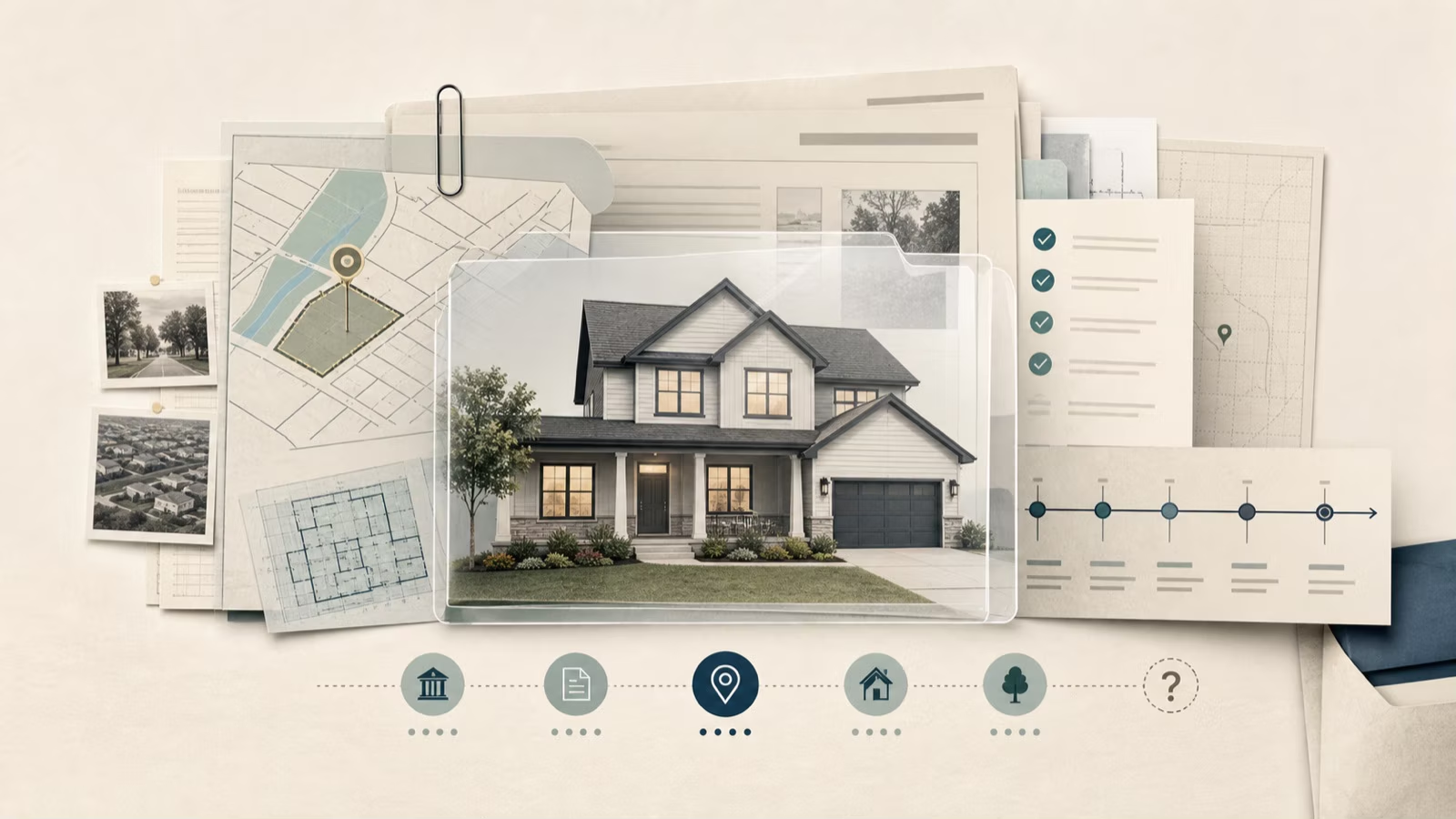
Start with the decision the report is supposed to support
A useful buyer report should help you decide whether a property deserves deeper diligence, which price evidence is credible, and which questions must be resolved before an offer or contingency deadline. It should not create the impression that one model output establishes condition, title, legal use, insurability, financing, or a guaranteed market value.
Write down the decision date and the action you are considering. A report created before a listing change, new disclosure, inspection, storm, permit update, or market shift may need refreshed evidence.
What does “property report” mean in US real estate?
“Property report” is not one standardized US document. The phrase can describe a consumer research dossier, a lender's property-data collection, a statutory subdivision report, or an informal bundle of public records. A title commitment, appraisal, and home inspection are separate professional products with different issuers and purposes. Name the document before deciding what its findings mean.
| Document or product | Typical issuer or preparer | Main purpose | What it does not prove by itself |
|---|---|---|---|
| Buyer research or property report | Research provider or buyer team | Organize dated facts, estimates, records, and unresolved checks | Seller identity, clear title, physical condition, insurability, or a guaranteed value |
| Property-data collection | Trained data collector or lender workflow | Capture property facts and observations for a stated mortgage process | A licensed appraisal, inspection, title search, or buyer due-diligence conclusion |
| Federal subdivision Property Report | Developer under the applicable federal land-sale framework | Disclose specified information before covered lot sales | A universal report for ordinary existing-home purchases |
| Title commitment or preliminary title evidence | Title insurer or title professional | State proposed coverage, requirements, and exceptions for a transaction | Current physical condition, legal advice, or removal of every title risk |
| Licensed appraisal | Appraiser for a stated client and use | Develop an opinion of value under the assignment scope | A home inspection, buyer affordability decision, or promise of sale price |
| Home inspection | Inspector under the inspection agreement and stated scope | Examine accessible physical systems and conditions | Ownership, title coverage, market value, or concealed-condition certainty |
Before paying for or relying on any product, record its issuer, intended user, scope, effective date, source list, update policy, and stated limitations. A polished document with no traceable sources or property match is not strengthened by calling itself “official,” “complete,” or “verified.”
What can a free property report realistically provide?
A free report can be a useful starting point when it identifies the exact parcel, shows which source supplied each field, gives an effective date, and leaves unavailable data blank. It is not complete merely because it displays a long property-history timeline. County coverage, record digitization, parcel matching, update intervals, and licenses vary; a missing sale, permit, lien, claim, or ownership event can mean the source did not expose it rather than that the event never existed.
Twellie's free property-report walkthrough explains the report format, source labels, limitations, and follow-up workflow and links to a clearly fictional sample. Entering an address does not generate a free address-specific result; it prepares a local buyer-brief draft for paid eligibility. The walkthrough cannot substitute for official records, a title search or commitment, an appraisal, an inspection, insurance, financing, or local legal advice.
Use the free walkthrough to decide which source-led questions deserve follow-up. Use the county assessor, recorder, tax authority, permit office, court, and other responsible offices for the specific official record. The owner-record guide shows how to reconcile names and instruments without treating one lookup as title clearance.
1. Verify the subject identity and effective date
Check the street address, unit, property type, parcel/APN when available, geocode, and the listing or property record being analyzed. Compare area, bedrooms, baths, lot, year built, legal use, and other material facts across the report's sources.
An apartment unit mismatch or conflicting property type can invalidate otherwise polished analysis. When a fact is ambiguous, the safe report behavior is to flag it and withhold downstream guidance that depends on it.
2. Read the source ledger before the conclusion
Every material fact should show where it came from, when it was retrieved, and what status the report assigns. A practical status vocabulary is:
- Supported: a traceable source directly supports the displayed fact.
- Partial: some evidence exists, but scope or fields are incomplete.
- Missing: the expected fact was not available from the attempted source.
- Conflicting: credible sources disagree and the difference is unresolved.
- Demo or fallback: the value is illustrative or non-live and must not drive a real purchase decision.
- Needs verification: the fact belongs with a professional, document, or current quote outside the report's authority.
Look for source concentration. Five modules repeating one upstream record are not five independent confirmations. Record the original provider and any transformations.
3. Separate four numbers that are often confused
| Number | What it represents | What it does not establish |
|---|---|---|
| Asking price | The seller's marketed price | Market value or affordability |
| Evidence estimate/range | View from accepted evidence | Sale price or appraisal guarantee |
| Licensed appraisal | Opinion for its stated client and use | Affordability or inspection |
| Buyer maximum | A personal financing and risk boundary | The property's market value |
Do not let a high personal limit pull the market evidence upward, and do not assume an asking price validates itself. During a mortgage application, other valuation products may use different data, timing, or purposes and can reasonably differ.
4. Audit the comparable-sales ledger
For each accepted comp, read the sale status, date, source, physical and location similarity, condition evidence, concessions when known, adjustments, weight, and reason included. Read the rejected candidates too. A report is more trustworthy when it explains why attractive but misleading sales were excluded.
Challenge the strongest comp: if it disappeared, would the conclusion materially change? Check whether accepted sales bracket the subject on major attributes and whether one sale dominates. Use the comparable-sales guide for a printable evidence ledger.
5. Understand the evidence range
Ask what creates the lower and upper bounds. Are they based on accepted comparable dispersion, a modeled interval, scenario assumptions, or an unexplained percentage around a point estimate? A range should widen or lose readiness when evidence is thin, conflicting, unbracketed, stale, or highly variable.
The label matters. An evidence range can summarize the spread and uncertainty in the available comps. A confidence or prediction interval makes statistical claims that require calibration and out-of-time testing. Do not treat those labels as interchangeable.
6. Trace every adjustment and assumption
An adjustment should identify its basis. Local paired sales or another relevant market source may support some differences; fixed national dollars for bedrooms, baths, condition, view, pool, or age should not appear as self-evident facts.
The same standard applies to cost assumptions. Property tax, insurance, HOA, utilities, maintenance, flood or wind coverage, and immediate repairs should show their source or be labeled estimates. A planning assumption is not a bill, quote, assessment, or promise of future cost.
7. Treat readiness as a gate, not a score to game
A report can distinguish states such as blocked, research only, or proceed with conditions. The important question is what evidence controls the state. A critical identity failure, demo source, missing buyer maximum, thin comps, or major conflict should not be averaged away by stronger cosmetic sections.
Read every condition attached to the status. “Proceed with conditions” does not mean the property is clear; it means the remaining work is explicit enough to assign and track.
8. Convert unresolved evidence into owned tasks
| Unresolved question | Appropriate next owner |
|---|---|
| Physical condition or suspected defect | Licensed inspector or relevant specialist |
| Ownership, lien, easement, boundary, or legal description | Title company or attorney |
| Legal use, zoning, or permit status | Local authority and qualified legal professional |
| Insurance availability, exclusions, or premium | Licensed insurance professional |
| Mortgage value and lending conditions | Lender and licensed appraiser |
| Contract language, deadline, or remedy | Appropriate real-estate attorney/representative |
Record the source to obtain, owner, deadline, response, and effect on the decision. Unknown should remain visible until the responsible person or document resolves it.
A five-minute report audit
Before relying on any property report, answer these ten questions:
- Is the exact property and unit confirmed?
- What is the report's effective date?
- Which facts come from live, traceable sources?
- Are any demo, fallback, missing, or conflicting sources present?
- Why was each accepted comp chosen?
- What happens if the strongest comp is removed?
- How were adjustments and range boundaries derived?
- Are asking price, evidence, appraisal, and buyer limit kept separate?
- Which critical facts remain outside the report's scope?
- Who owns each next check, and by what deadline?
Open Twellie's sample home-buyer property report and apply this audit directly. The methodology documents the current evidence and readiness rules, while the due-diligence checklist covers the professional and transaction work an online report cannot complete.
